AI Video Is Everywhere. Good Filmmaking Is Still Rare.
Why the next generation of brand advertising needs more than powerful AI tools.
By ANDRIX · 14 November 2026 · 5 min read
The AI Video Revolution Is Already Here
Not long ago, producing a cinematic commercial required significant budgets, production crews, locations, cameras, lighting and extensive post-production.
Today, artificial intelligence can generate spectacular imagery from a few lines of text.
A futuristic city. An impossible camera movement. A cinematic battle sequence. A world that previously existed only in someone's imagination.
All achievable without setting foot on a traditional film set.
And brands are paying attention.
According to the Interactive Advertising Bureau's 2026 Digital Video Ad Spend & Strategy report, the proportion of surveyed US digital video advertising buyers using generative AI for creative production increased from 51% in 2025 to 62% in 2026.
In Singapore, CNA reported in August 2026 that advertising agencies were experiencing growing demand for AI-generated content, alongside concerns about quality and consumer reactions.
The technology is no longer experimental.
But as AI video becomes more accessible, an uncomfortable question is emerging:
If everyone can generate cinematic-looking videos, what makes a good commercial anymore?
Generating a Video Is Not the Same as Directing One
AI video tools have become remarkably capable.
With the right prompts, almost anyone can generate impressive visuals.
But impressive visuals do not automatically make an effective film.
A commercial needs more than beautiful images.
It needs a concept worth remembering. A story that connects with its audience. Visual continuity. Intentional pacing. Performances that communicate emotion. Sound and music that support the message.
Most importantly, it needs creative decisions that serve a purpose.
A beautifully generated scene can still fail if the audience doesn't understand what is happening, why it matters or what they are supposed to feel.
This is where traditional filmmaking knowledge becomes increasingly valuable.
Understanding cinematography, editing, storytelling, visual effects and directing is not becoming obsolete.
If anything, these skills are becoming more important.
Because AI can generate the shots.
But someone still needs to know which shots belong in the film.
The Problem With AI Videos That Look Like AI Videos
We've all seen them.
Perfectly polished characters. Impossible camera movements. Spectacular environments. Everything looks impressive, yet something feels strangely disconnected.
Sometimes it's inconsistent characters.
Sometimes it's unnatural movement or visual details that change between shots.
Other times, the imagery is simply overwhelming, with no clear storytelling direction.
For a personal experiment, these imperfections may be acceptable.
For a brand, they can become a problem.
A commercial represents the identity, reputation and credibility of the company behind it.
When audiences notice distracting visual inconsistencies, the technology becomes the centre of attention instead of the brand's message.
This doesn't mean brands should avoid AI.
It means they should approach AI production with the same creative discipline they would expect from any professional film production.
The objective should never be to make something look AI-generated.
The objective should be to create something worth watching.
The Future Isn't AI Versus Traditional Filmmaking
One of the most misleading conversations surrounding AI video production is the idea that brands must choose between traditional filmmaking and AI.
We believe the future is more interesting than that.
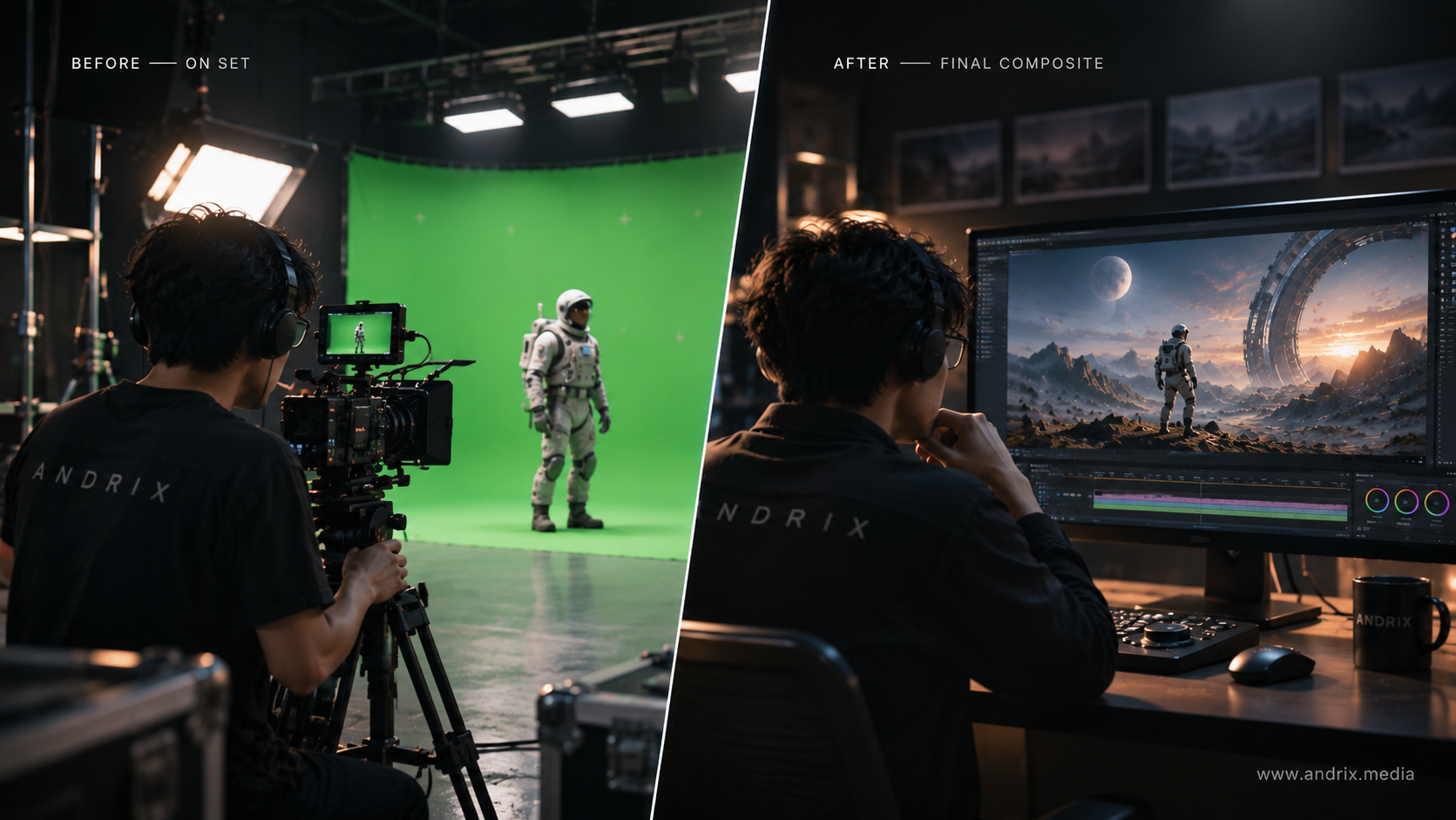
Imagine filming a spokesperson in a modest studio, then placing them inside an extraordinary cinematic environment.
Or shooting a product with a real camera, preserving its physical details and authenticity, while using AI-assisted visual effects to transform the world around it.
A relatively simple production can become something much more ambitious.
This hybrid approach brings together the strengths of different disciplines.
Live-action filmmaking provides authentic performances, real-world details and precise control over physical products.
Traditional visual effects and 3D production provide consistency, compositing control and technical precision.
AI-assisted production expands creative possibilities and can reduce the resources needed for certain shots, environments and visual concepts.
Each technique has strengths and limitations.
The skill lies in knowing when to use which.
Not every shot needs AI.
Not every scene needs a physical set.
And not every creative idea requires a blockbuster budget.
The best production approach is the one that serves the story and the client's objectives.
Lower Production Costs Shouldn't Mean Lower Creative Standards
One of AI's most exciting possibilities is making ambitious filmmaking more accessible.
Ideas that previously required extensive production resources can now be explored with smaller teams.
For businesses with limited marketing budgets, this opens new creative opportunities.
A small brand might develop a cinematic product commercial.
A corporate event could incorporate an imaginative narrative that would previously have been difficult to produce.
An advertising agency could explore ambitious visual concepts without immediately committing to expensive location shoots or large-scale sets.
But reducing production costs does not eliminate the need for planning.
AI-assisted filmmaking still requires creative development, storyboarding, visual direction, asset consistency, editing, sound design and quality control.
And sometimes, achieving a specific result takes substantial iteration.
The real value of AI isn't that every video suddenly becomes cheap.
It's that filmmakers can achieve more with the resources available.
What Brands Should Look for in an AI Video Production Partner
As more studios and independent creators begin offering AI video services, choosing the right production partner becomes increasingly important.
Before commissioning an AI commercial, brands should consider a few questions.
Can the team tell a story?
Look beyond individual impressive shots. Can the studio create a complete film with coherent storytelling, intentional pacing and a clear message?
Can they maintain visual consistency?
Characters, products, environments and brand elements should remain recognisable across shots.
Do they understand commercial production?
A visually impressive video is not necessarily an effective advertisement. The production should support the campaign's objectives and audience.
Can they combine different production techniques?
The ability to work with live action, animation, VFX and AI provides more creative flexibility than relying on one technology alone.
Do they understand the limitations of AI?
A professional production partner should be transparent about what AI can achieve reliably, where it may struggle and when another technique would deliver a better result.
Brands should also discuss usage rights, likeness permissions, confidentiality and how generated assets will be reviewed before publication.
Ultimately, clients are not simply buying access to AI tools.
They are investing in creative judgment, production experience and a finished piece of communication that represents their brand.
Filmmakers First. Technology Forward.
At ANDRIX, we see AI as an extension of filmmaking, not a replacement for it.
Our studio combines decades of experience in filmmaking, animation and visual effects with emerging AI-native production workflows.
Co-founded by filmmakers and creative technologists, including a former Lucasfilm visual effects artist, ANDRIX was built around a simple belief:
Technology should expand imagination, not dictate it.
We work across cinematic AI video production, live-action filmmaking, animation and next-generation visual effects.
Sometimes a project calls for an entirely AI-assisted production.
Sometimes it needs real footage enhanced through visual effects.
And sometimes the strongest result comes from combining several techniques.
What matters is the outcome.
A film that communicates clearly.
A visual experience that feels intentional.
A story that audiences remember.
Because as AI video becomes increasingly common, the competitive advantage will not simply belong to those with access to the newest tools.
It will belong to those who know how to use them to tell better stories.
AI can make extraordinary images possible. Good filmmaking makes them meaningful.